Etsy print on demand: how to set up and sell
A practical Etsy POD setup guide for sellers who want original shirt ideas, honest listings, and a production partner they can trust.


On this page
Etsy print on demand is a clean way to sell original shirt ideas without filling a closet with inventory. Your job is still the hard part: make work people want, write an honest listing, set a price that leaves room for fees, and choose a production partner you can stand behind.
Short answer
To sell print on demand shirts on Etsy, start with an original design and a narrow buyer. Build a truthful listing, disclose the production partner where Etsy asks for it, then connect that listing to a printer that can make the exact tee and print placement you promised. Test one listing before trying to build a hundred.
What Etsy print on demand actually means
Print on demand means a shirt gets printed after someone buys it. You do not buy a run of fifty tees first. You create the design, build the listing, and send the order to a production partner. That partner makes and ships the physical item.
The low inventory risk is useful, but it does not make the business automatic. Etsy shoppers still judge the design, photo, fit, price, delivery estimate, and whether the listing feels honest. A generic slogan on a generic mockup has a hard time earning a click, much less a repeat customer.
Production partnerthe company that makes the physical item
For a print on demand shirt, the seller supplies the original design and listing. The production partner prints and ships the tee. Check Etsy's current production-partner guidance before you publish, then describe that relationship accurately in your shop.
| You handle | Your production partner handles | The customer sees |
|---|---|---|
| Original design and niche | Printing the shirt | A listing that matches the delivered tee |
| Title, tags, price, and customer service | Quality checks and shipment | Clear size, color, and timing details |
| Accurate partner disclosure | Making the selected variant | A made-to-order order, not a mystery box |
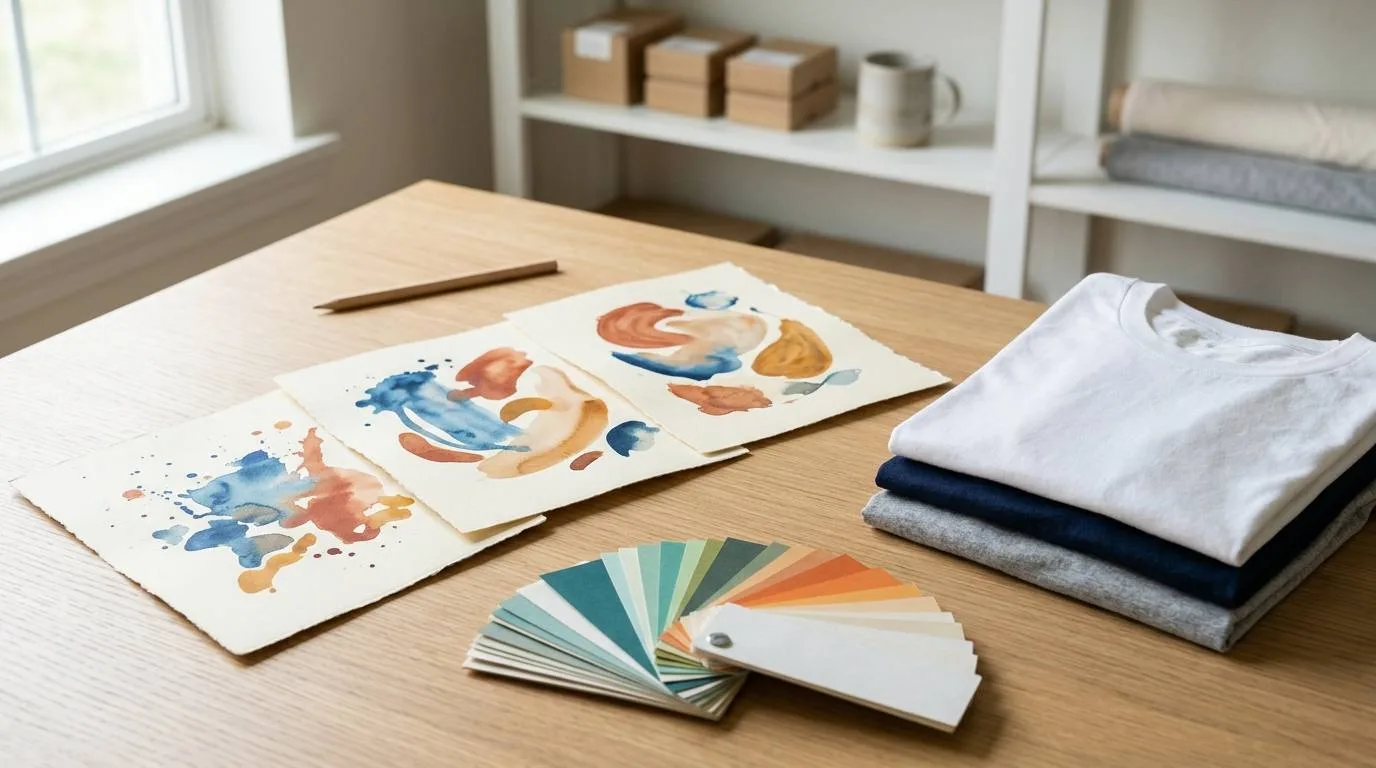
Pick the shirt color after you know how the art reads on cotton, not before.
Start with a buyer, not a shirt blank
Choose one small lane where you can make several distinct ideas. That could be a hobby, job, pet type, family role, local activity, or a specific sense of humor. "Funny shirts" is too broad. A shirt for people who care for senior dogs gives you more to work with: the jokes, colors, visual motifs, and buyer language become clearer.
Do a fast originality check before you draw anything. Search the phrase you want to use, look for protected names and logos, and do not trace a bestseller until it is one pixel different. A shirt can be inspired by a broad format, such as a simple two-color camping graphic, without borrowing another seller's art or distinctive wording.
If you need a workflow for turning an idea into a file, our t-shirt design workflow covers the practical checks: readable type, clean edges, enough resolution, and a transparent background when the art calls for it.
At a glance
| Start small | Launch 5 to 12 connected designs, not 80 unrelated ones. |
| First goal | Learn which thumbnail earns clicks and which design earns orders. |
| Do not skip | Originality checks, accurate listing copy, and a sample order. |
Build a listing that survives the scroll
Your first image has one job: make the shirt easy to understand at phone size. The design needs to be visible, the shirt color needs to be obvious, and the mockup should not pretend the buyer is getting a different garment. Add clear views for alternate colors and placement, then use the rest of the listing to answer fit, material, care, and delivery questions.
Write the title for a human first. Lead with what the shirt is and who it is for. Use the description to explain the design, list sizes and colors, state that it is made to order, and tell buyers how personalization works if you offer it. Avoid claims you cannot prove, especially delivery promises and material claims copied from another printer.
Do this
Show the actual shirt style, name the fit, and make the design legible in the first image.
Not this
Use a beautiful lifestyle image where the tee, color, and print are impossible to inspect.
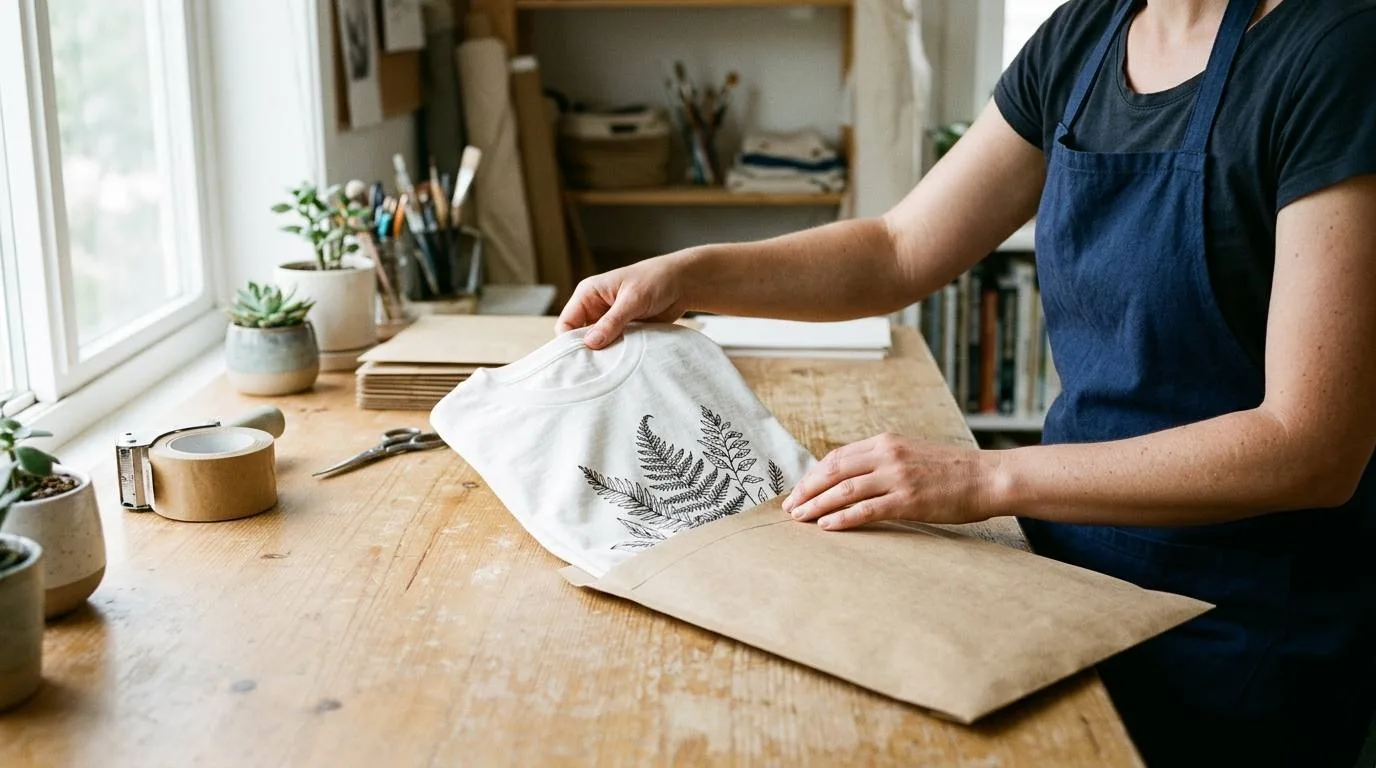
For a real listing, pair lifestyle imagery with clear product views that show the exact tee and print placement.
Run the numbers before you hit publish
Price the actual order, not the fantasy order. Your shirt cost, shipping, Etsy fees, any ads, refunds, and the time you spend helping customers all count. A low sticker price can look smart until the first replacement order wipes out the profit from several sales.
Toolbox POD's live price list currently starts a one-side Gildan 64000 at $8.59 for sizes S to XL, with $5.95 flat shipping per order. A Comfort Colors 1717 starts at $11.59. Both are printed DTF, and a second printed side adds $5.00 per shirt. Those are production costs, not a suggested Etsy retail price. Use the price page for the current numbers, then decide what your buyer will pay and what shipping policy you can explain without hand-waving.
A simple one-tee cost check
Toolbox POD prices checked November 3, 2026. Shipping is per order, so the math changes when a buyer adds shirts.
A sample order is part of the math. It lets you see the color, print scale, shirt feel, packaging, and arrival experience before a customer has to discover the weak spot for you. Read what DTF changes for a shirt print if you need a plain-English view of the process.
Connect the printer and test one complete order
Make one strong design
Pick a narrow buyer and create art you own. Keep type large enough to read in a listing thumbnail.
Choose the tee and colors
Start with a small color set that works with the ink. Toolbox POD offers the Gildan 64000 and Comfort Colors 1717 in sizes S through 3XL. See the full options on the shirt page.
Write the listing with the partner in mind
Use your real production times, care notes, and variant details. Complete Etsy's production-partner information honestly.
Order your own shirt
Check print placement, color, size, packaging, and the tracking flow. Fix the listing if the sample and photos do not line up.
Launch, then pay attention
Watch which listing image earns favorites and which questions keep arriving. Improve one variable at a time so you know what changed.
Do not borrow trouble
Do not sell unlicensed characters, sports marks, band names, or copied artwork because other listings appear to get away with it. A listing that earns fast clicks and gets removed is not a business asset.
Questions Etsy sellers ask
Can you sell print on demand shirts on Etsy?
You can use a production partner for shirts when your listing and shop follow Etsy's current rules. Keep the design original, disclose the production partner where required, and represent the item and production process accurately.
How many Etsy POD designs should I launch with?
Start with a connected small collection, often 5 to 12 designs for one buyer or occasion. That gives shoppers a reason to browse while keeping your photos, titles, and customer questions manageable.
What should I charge for an Etsy print on demand shirt?
Work backward from production cost, shipping, Etsy fees, refunds, and the margin you need. Do not copy another seller's price until you know their shirt, shipping method, and ad spend are comparable to yours.
Should I order a sample before selling on Etsy?
Yes. A sample lets you check print scale, color, fit, packaging, and the buyer experience. It is cheaper to revise your listing before a customer orders than after a complaint.
The bottom line
Etsy POD works when the design, listing, and production promise all agree. Start with one buyer, make something original, calculate the real cost, and order the shirt yourself. That is enough to build a useful first listing.
Turn one good idea into a real shirt Choose a tee, upload your art, and see the live cost before you build the listing around it. |